
NEWS
Newark’s Phone Ban Starts as a Storage Problem
Newark’s first bell-to-bell phone ban puts devices in lockable pouches, leaves storage local, and sends parent texts to the school office.

Newark Public Schools opened the 2026-27 year on September 8 with personal phones powered off under New Jersey’s first statewide bell-to-bell device ban. The district, which enrolls just over 43,200 students, is the state’s largest, and its calendar lists the first day of school on September 8.
The law bars use. It does not empty backpacks. Storage, enforcement, and how a parent reaches a child now sit with each board, including Newark’s.
Phones Stay in the Building, Powered Off
Former Gov. Phil Murphy signed P.L.2025, c.195 on January 8, 2026, at Ramsey High School, 12 days before he left office. The statute tells every public board, including charter schools and renaissance projects, to adopt a policy that bars non-academic use of personal internet-enabled devices for the whole school day, with limited exceptions.
“By removing cell phones from New Jersey schools, we are ensuring our classrooms are a place for learning and engagement, not distracting screens that detract from academic performance,” Murphy said when the Department of Education issued follow-up guidance a week later.
Bell-to-bell means the opening bell through dismissal. Lunch counts. So do hallways, bathrooms, and the minutes between classes, which is where students used the phone as a social tool. Devices covered include smartphones, tablets, smartwatches, and smart glasses. They must be powered off, not set to silent or vibrate. School-issued devices used for class are outside the ban, so a Chromebook can stay in a student’s hands while a personal phone cannot.
The commission that studied teen social media use, in its Growing Up Online executive summary, cited research that 25% of adolescents spend over 2 hours on phones during the school day. That finding sat behind the push. The statute still leaves the hard part to local boards: where the powered-off phone actually lives from morning until the last bell.
THE PATH TO THE FIRST BELL
- September 2025: The Commission on the Effects of Social Media Usage on Adolescents recommends a bell-to-bell ban in Growing Up Online.
- October 2025: The state launches the Phone-Free Schools Grant Program to pay for storage and staff training.
- December 18, 2025: Officials announce 86 awards, with Newark taking the largest check.
- January 8, 2026: Murphy signs the bell-to-bell law at Ramsey High School.
- January 15, 2026: The department releases updated guidelines on student internet-enabled devices.
- Spring 2026: Malcolm X Shabazz High School pilots pouches after spring break.
- June 2026: The Newark board approves a Yondr pouch purchase capped at $99,000.
- September 8, 2026: Newark students start the year under the new rules.
Education Commissioner Kevin Dehmer said those guidelines were written to let each community choose storage, supervision, and enforcement based on its own capacity. Gov. Mikie Sherrill has said she supports the mandate. Assemblywoman Rosy Bagolie, a Democrat from Essex County and the superintendent in East Newark, sponsored the bill after running a surrender policy in her own small district for five years.
Newark’s $99,000 Pouch Order Covers a Slice
In December 2025, Newark Public Schools received $176,625.08 through the state’s Phone-Free Schools Grant Program, the top award in a round of about $980,000 across 86 districts and charters. The money came from a $3 million line in the fiscal 2026 budget. Four Newark charter schools drew smaller checks of their own.
NEWARK’S SHARE OF THE PHONE-FREE GRANTS
| Recipient | Maximum award |
|---|---|
| Newark Public School District | $176,625.08 |
| Team Academy Charter School | $24,752.62 |
| Great Oaks Legacy Charter School | $9,022.78 |
| Gateway Academy Charter School | $4,367.16 |
| Maria L. Varisco-Rogers Charter School | $1,490.44 |
The district and those four charters together accounted for about 22% of the round. The state’s Phone-Free Schools Grant awards were meant to buy lockers, locked pouches, or check-in cabinets, and to train staff. In June, Newark’s board approved lockable Yondr pouches at a cost not to exceed $99,000, using state funds, well under the district’s grant.
Yondr markets the cases at $20 to $25 per student and says they are used by three million students. At those prices, a $99,000 cap buys about 4,000 to 5,000 pouches. That is a fraction of a district with just over 43,200 students. The leftover grant can still go to training or other storage, but the board vote is not a pouch on every desk in every school.
Superintendent Roger León put the legal floor in plain words at a January board retreat, before the purchase: “From bell to bell, there are no cell phones in schools starting next school year. That includes Newark Public Schools. So it is what it is.” The plan students actually carry is narrower. Phones may come to school if they stay off and inside pouches from the first bell to the last.
Lock, Carry, Unlock at the Door
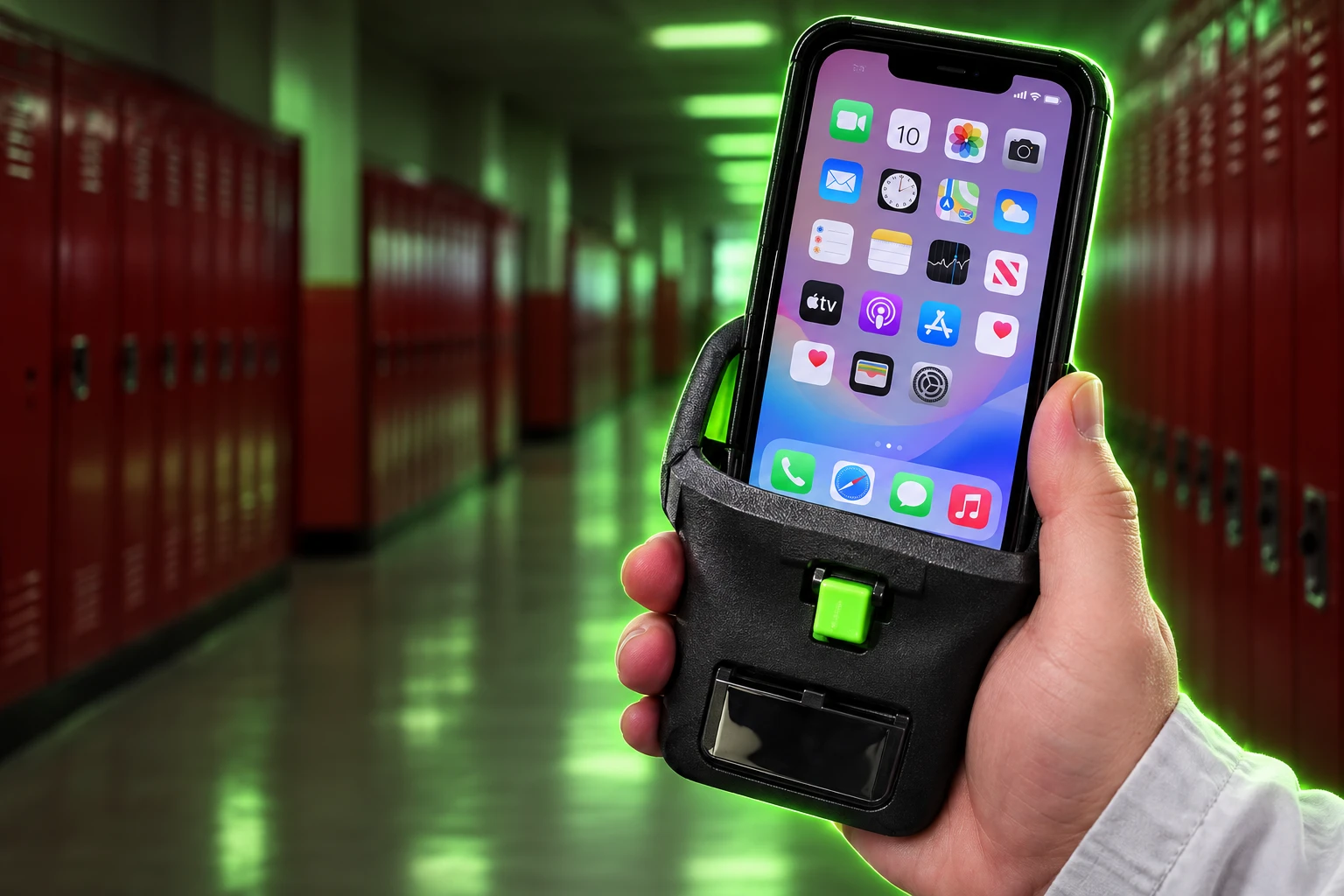
Yondr’s pitch is that the phone stays with the student and still cannot be used. The company describes a lockable pouch students carry through a 6 to 8 hour break from the device, with magnetic stations at arrival and dismissal so teachers are not collecting a pile of phones.
HOW A LOCKABLE POUCH RUNS THE DAY
- Arrival: The student powers the phone off, slides it into the assigned pouch, and closes the magnetic lock before heading to class.
- The day: The sealed pouch stays with the student or in a locker; the device cannot be used in class, at lunch, or in the halls.
- Dismissal: The student taps the pouch on an unlocking magnet at a designated station and takes the phone back.
- A break-in: If the pouch is forced or stolen, the school treats it as a policy violation, not a lost-and-found errand.
That routine only works if staff watch the lock, the magnet line at the door, and the kid who shows up with a dummy pouch. Newark already learned that last spring.
A Parent’s Call Now Goes to the Office
Malaya Lhill, 14, started as a freshman at University High School this year. Her previous school used lockboxes, so a full-day ban is not new to her, but the missing weight in a pocket still is. “Sometimes I’d reach my hand in my pocket and I would think my phone’s there, but it’s not,” she said in August. “And I like my phone because I can get in touch with my mom during school.”
Her mother, Royanda Phillips, said she understands the classroom case and still wants a direct line.
So I get it on both ends, but as a parent, I just feel like if I need to contact my child directly, I’ll have to call the office. And then it’s like, ‘OK hold on, let me see what class she’s in, let me try to see where she is in the building,’ instead of having direct contact with my child.
Royanda Phillips, parent of a University High School freshman
State guidance discourages parents from texting a child’s personal phone during the day and tells districts to spell out another path. In practice that path is the main office, a nurse, or an administrator who has to locate a student in a large building. For pickup changes, a late bus, or a family emergency, the old text thread is gone unless the student has a documented exception.
The adult complaint on the first week of school is the same as the student one, from the other side of the line. Lunch and hallways used to be when a parent could ping a child. Bell-to-bell closes those windows on purpose.
What the Shabazz Pilot Changed
Joicki Floyd, a Newark Teachers Union vice president who teaches at Malcolm X Shabazz High School, said the school piloted the ban after spring break last year. Staff enforced it together. Students were more engaged, she said, and teachers could see skill gaps that a phone used to hide. Seniors wearing pouches also pulled younger students into the habit.
Students were definitely more engaged, more focused, and then we were able to see where they lacked in certain skills, so that we would be able to accommodate what they did not know or what they needed to learn.
Joicki Floyd, vice president, Newark Teachers Union, Malcolm X Shabazz High School
The pilot was not clean. Floyd said there were one or two cases where students learned how to open pouches or stole them. Shabazz set fines at $5 for a warning and up to $20 to replace a pouch. That is the unglamorous half of a lockable case: it is a lock only until someone treats it as a puzzle, and then the cost lands on the student or the school.
Erica Wright, an incoming teacher at Marion P. Thomas Charter School who previously taught in Orange, said a pouch rule there helped social skills and that the grind was getting students used to the lock. Divine Kibe, the Newark board’s student representative, told members in January that peers wanted the rules explained before the first bell, so expectations were understood. The policy’s success still hangs on that adult-student agreement, school by school, more than on the statute’s text.
Districts Pick Pouches, Lockers, or Backpacks
The January guidance lists storage as a local choice. A board can buy locked pouches, run school-managed lockers or bins, keep a classroom caddy, or tell students to leave the powered-off phone in a backpack or locker. Neighboring towns can look like different systems on the same bus route. Some North Jersey schools that opened as early as September 2 told students to power down and stash devices in lockers or bags. Cherry Hill’s amended policy lets students keep a phone with personal belongings, as long as it stays off.
STORAGE METHODS THE STATE LEFT OPEN
| Method | Who holds the device | Access during the day |
|---|---|---|
| Locked pouch (Yondr-style) | Student carries a sealed case | Unlocks at dismissal magnets |
| School lockers or bins | Staff control the storage | Staff retrieve in an emergency |
| Classroom caddy or cabinet | Teacher manages a room set | Limited to that class period unless collected for the day |
| Student backpack or locker | Student, device powered off | Honor system plus confiscation if seen or heard |
That menu is why a statewide ban does not produce a statewide morning. A pouch district spends money and staffs magnet lines. A backpack district spends almost nothing and spends the year arguing about a phone that buzzed in a hoodie. Newark split the difference: a limited pouch buy on top of a carry-it-off rule, after a high school pilot that already needed replacement fines.
Who Still Gets a Phone During Class
The law and the department’s FAQ already carve holes, and the New Jersey Education Association, which lobbied for the bill, laid out exceptions for caregivers and translation along with health and special education rules. A principal, superintendent, or designee can also authorize use when no other option meets the same need.
EXCEPTIONS WRITTEN INTO THE LAW
- IEP or 504: A device required to carry out an individualized education program or a Section 504 plan stays available.
- Health plan: A phone used to follow a documented student health plan, with paperwork from a parent and a clinician, is allowed.
- Translation: Students may use a device for translation services.
- Caregiving: A student who is a routine caregiver for a family member can get a case-by-case exception under set conditions.
- Emergency: District policy must say how phones come out in an emergency, and staff still direct when it is safe to power on.
- Classwork: A building leader may grant a reasonable accommodation for an educational purpose.
Those exceptions are the parent-contact valve the statute actually wrote. They are not a general texting hour. A family that wants a same-day pickup still calls the office unless the student already qualifies. Boards may write a stricter rule than the floor. They cannot skip the health, disability, translation, caregiving, or emergency cases.
On the sidewalk after the last bell, the magnet releases and the phone lights up again. Until then, Newark’s version of a statewide ban is a powered-off device in a pouch some students were issued, a backpack rule for the rest, and a main office that now handles the texts that used to go straight to a child’s pocket.

Musk Blames Indian Oligarchs While Starlink Waits in Line

France Extends Its Soda Tax to Packaged Biscuits and Cereal

Hormel Bets $1.055 Billion on Brakebush Restaurant Chicken

Hyundai Bets the 2027 Tucson on Hybrids, Not Plugs

Hyundai Bets the 2027 Tucson on Hybrids, Not Plugs

EIF’s €30 Million Pushes Nordic Foodtech Close to €80 Million
Hyundai Bets the 2027 Tucson on Hybrids, Not Plugs

AI Agents Can Act, but Someone Has to Own Them

Bass Persuades Puts Miley Back at No. 1 on Sales

Ocarina of Time’s Australia Listing Matches Yoshi at $59.99
-
 BUSINESS1 month ago
EIF’s €30 Million Pushes Nordic Foodtech Close to €80 Million
-
 AUTO3 weeks ago
Hyundai Bets the 2027 Tucson on Hybrids, Not Plugs
-
 NEWS1 month ago
AI Agents Can Act, but Someone Has to Own Them
-
 ENTERTAINMENT3 weeks ago
Bass Persuades Puts Miley Back at No. 1 on Sales
-
 GAMING1 month ago
Ocarina of Time’s Australia Listing Matches Yoshi at $59.99
-

 NEWS1 month ago
LG Smart TVs Still Scan Homes Behind Apple TV
-

 NEWS1 month ago
Sembly 3.0 Makes Branded Decks and Shifts the Bottleneck
-

 NEWS1 month ago
Cheaper Tokens Made AI Deployments Cost Enterprises More