
BUSINESS
Hormel Bets $1.055 Billion on Brakebush Restaurant Chicken
Hormel will pay $1.055 billion for Brakebush as CEO-elect John Ghingo shifts into restaurant chicken after a year of disposals.

Hormel Foods agreed on Sept. 30 to pay $1.055 billion in cash for Brakebush Brothers, a family chicken processor that sells almost all of its volume into restaurants. John Ghingo, the president who will take over as chief executive on Oct. 26, is attaching his first chapter to that check.
Brakebush posted about $1.2 billion in sales over the last 12 months. Hormel does not expect the deal to add to adjusted earnings per share until fiscal 2028, and it will book the business mainly inside Foodservice, the slice of Hormel that already supplies about half the company’s profit.
Ghingo Bets Hormel’s Next Chapter on Foodservice Chicken
On Sept. 29, Hormel signed a membership interest purchase agreement to acquire Brakebush Brothers from the Brakebush family. The base price is $1.055 billion in cash, subject to ordinary closing adjustments, and the company wants the deal done in the first quarter of fiscal 2027.
Ghingo has been president and a director since July 2025, after rejoining in 2024 to run Retail. The board named him CEO on July 28, with the handoff set for fiscal year-end, 26 days after the Brakebush announcement. Jeff Ettinger stays interim chief through Oct. 25 and remains on the board.
On the Sept. 30 investor call, Ghingo said Brakebush is exactly the type of business Hormel had been looking to add. Protein, he said, remains one of the most attractive long-term openings in food, and chicken keeps gaining ground with diners and operators.
Chicken has been one of the most attractive growth categories in protein, and Brakebush has built an exceptional platform to serve that demand. Hormel Foods has built a strong Foodservice business by helping operators succeed through innovation, service and value-added solutions.
John Ghingo, president and chief executive officer-elect, Hormel Foods announcement, Sept. 30, 2026
Ettinger put the mix in plainer numbers. Chicken has been under 5% of Hormel’s business; after Brakebush it will be closer to 13%. Foodservice grew organic sales for a 12th straight quarter in the period ended July 26, even as the rest of the company felt weaker turkey commodities, bacon, and a retreat from some private-label snack nuts.
Hormel already sells a kitchen shortcut it calls Flash 180: pre-prepped breaded chicken that Ghingo has described as 180 seconds from package to plate, against 10 to 12 minutes if a restaurant batters raw bird in the fryer. Brakebush is that idea at $1.2 billion of scale, built on tenders, boneless wings, patties, nuggets, and other further-processed cuts.
Five Plants, No Farms and a Direct Sales Force
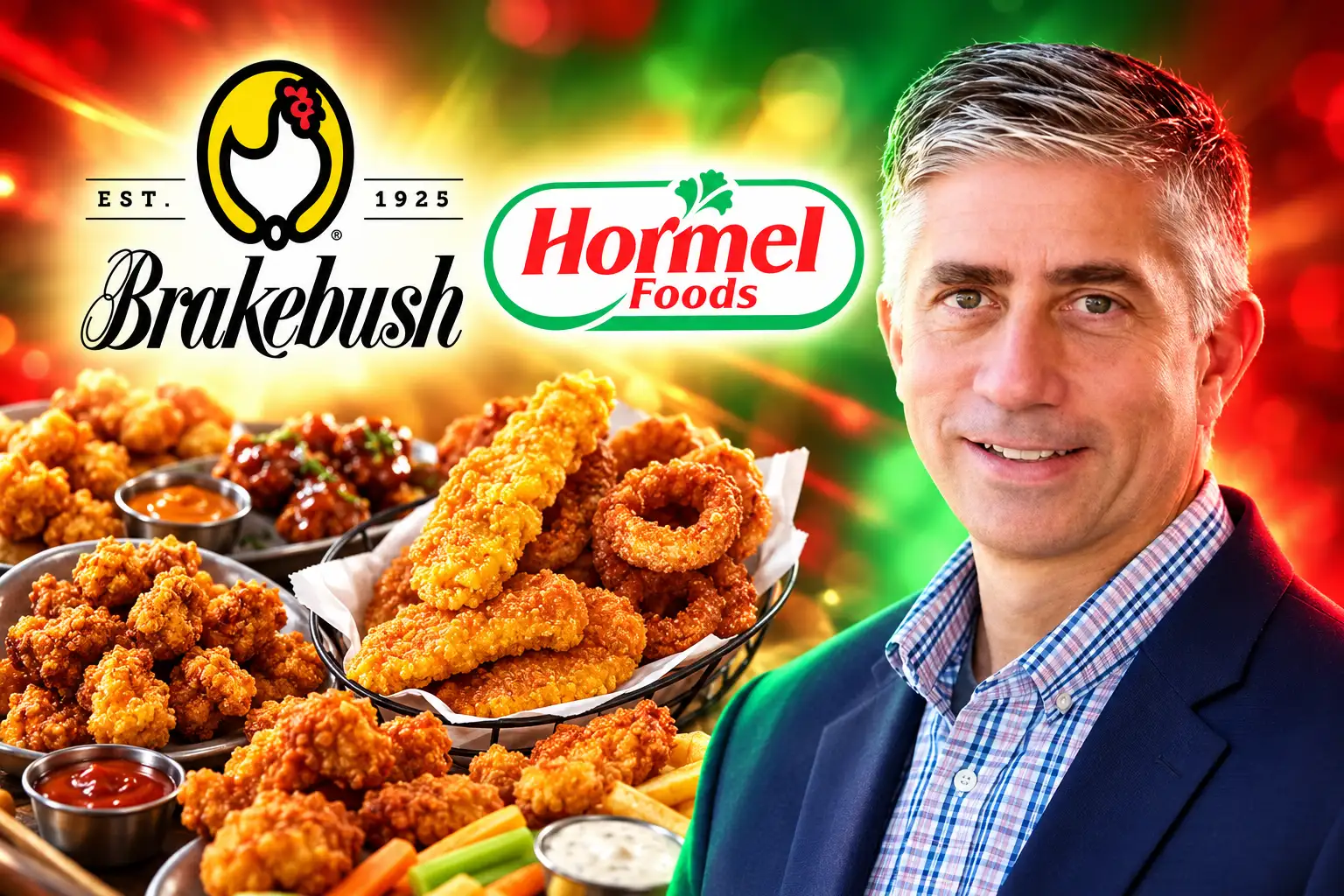
Brakebush started in 1925 and is based in Westfield, Wisconsin. Hormel describes it as a leading value-added, non-vertically integrated chicken company, which means it does not own hatcheries, grow-out farms, or slaughter lines. It buys raw chicken and sells it cooked, par-fried, or raw-portioned to national and regional operators, plus a thin retail tail.
The company’s investor presentation splits Brakebush’s fiscal 2025 commercial sales at about 90% foodservice and 10% retail. That is the hinge of the bet. Hormel already has Applegate, Hormel Natural Choice, and Jennie-O in grocery protein. What it is buying is a direct sales force, operator relationships, and five plants that sit closer to the fryer than to the barn.
BRAKEBUSH PRODUCTION MAP
| Location | What it does |
|---|---|
| Westfield, Wisconsin | Headquarters and further-processed production |
| Irving, Texas | Raw portioning |
| Mocksville, North Carolina | Further-processed production |
| Wells, Minnesota | Production |
| Hartwell, Georgia | Raw, sized, and marinated chicken; bought from Lake Foods on Dec. 31, 2023 |
Two research and development labs sit alongside those plants. Carey Brakebush, the company’s chairman, said the family had always run a people-first business and saw the same traits at Hormel. Wells Fargo advised Hormel. William Blair advised Brakebush.
Gregory Huff, Brakebush’s president and chief executive when the Hartwell plant was added, had said that fifth site would help the firm hold current accounts and chase new ones. Hormel now inherits that network as a subsidiary inside Foodservice, with Ghingo saying the near-term job is to keep both Hormel foodservice and Brakebush performing rather than mash the brands together on day one.
Why Hormel Sold Whole Birds and Kept Jennie-O
Ghingo called Brakebush the fourth portfolio move in about a year, after Justin’s, whole-bird turkey, and Brazil. The investor slides put those exits in one column and foodservice plus value-added chicken in the other. The company is not leaving turkey. It is leaving the bird that trades like a commodity every holiday season.
THE YEAR HORMEL SHRANK TO MAKE ROOM
- December 15, 2025: Sells 51% of Justin’s, LLC to Forward Consumer Partners for $75.8 million in cash and books a $22.0 million pretax gain as the nut-butter brand leaves consolidation.
- February 26, 2026: Agrees to sell the whole-bird turkey business to Life-Science Innovations, keeping the Jennie-O brand and value-added turkey.
- April 24, 2026: Closes that turkey sale for $61.2 million, including $21.2 million in cash and a $40.0 million note, and records a $60.8 million pretax loss.
- June 29, 2026: Agrees to sell Ceratti in Brazil to Zanchetta Alimentos; financial terms are not disclosed.
- July 28, 2026: Names Ghingo chief executive, effective Oct. 26, 2026.
- August 27, 2026: Cuts full-year sales guidance after a third quarter of $2.96 billion in net sales, with organic sales down 2%.
- September 29, 2026: Signs the Brakebush purchase agreement, announced the next morning.
The turkey close handed LSI the Melrose, Minnesota, whole-bird plant, a Swanville feed mill, trucks, and grower contracts. Hormel kept ground turkey, deli meat, bacon, franks, and the right to sell Jennie-O Oven Ready whole birds. In one fiscal year it took $21.2 million in cash for assets that sit next to live animals, then agreed to pay $1.055 billion for plants that buy their raw material from someone else.
August’s guidance change is the other half of the setup. Hormel now expects fiscal 2026 net sales of $12.1 billion to $12.2 billion, reflecting organic net sales growth of 1% to 2%, down from a prior 1% to 4% band and a prior sales range of $12.2 billion to $12.5 billion. It raised adjusted operating income to $1.08 billion to $1.12 billion and adjusted earnings per share to $1.45 to $1.51, both implying 6% to 10% growth, while cutting diluted EPS to $1.06 to $1.12 from $1.28 to $1.37.
Chicken at 13%, Matching the Turkey Share
Hormel’s own pro forma math, using the 12 months ended July 26, 2026, is the cleanest picture of what the check buys. Foodservice rises from about a third of sales to 40%. Chicken, now a rounding error beside pork, draws even with turkey and beef.
PRO FORMA MIX AFTER BRAKEBUSH
| Cut of the company | Share of net sales |
|---|---|
| Retail | 55% |
| Foodservice | 40% |
| International | 5% |
| Pork | about 40% |
| Turkey | about 13% |
| Chicken | about 13% |
| Beef | about 13% |
| Non-meat | about 20% |
Those protein shares may not add to 100 because of rounding, the company warned. The direction is still the point Ghingo is making: pork stays the core, turkey is held as a branded, value-added line, and chicken is no longer a side bet.
Foodservice is carrying the argument on current numbers, not just slides. In the first nine months of fiscal 2026 the unit’s sales rose 5% to $3 billion from $2.9 billion, and segment profit rose 9% to $457 million from $420 million. In the third quarter, foodservice sales were about $1.00 billion, up 2%, with segment profit up 3%. Ghingo has said the value-added chicken category in foodservice has grown at a mid-single-digit rate for more than five years, and that Brakebush has beaten that trend.
Cash on Hand Covers Only Part of the Bill
Hormel held $840 million of cash on July 26, 2026, up $169 million from the end of fiscal 2025. That pile does not cover a $1.055 billion cash price. The company said it will finance the deal with cash on hand and long-term debt, and that it intends to keep a strong investment-grade rating.
Net debt to adjusted EBITDA was 1.5 times for the 12 months through the third quarter, inside a long-term target of 1.5 to 2.0 times. After closing, Hormel expects that ratio in the low-2 times area, a touch above the band, and says combined cash generation should bring it back inside the range during fiscal 2027. The last time the ratio sat at 2.0 times was fiscal 2021, the year it bought Planters.
That Planters purchase, announced on Feb. 11, 2021, and closed on June 7, 2021, was $3.35 billion in cash for Kraft Heinz’s snack-nut brands. Jim Snee, then chief executive, called it the largest acquisition in the company’s history. Brakebush is the biggest check since that deal, and it lands on a stock that has been asked to accept slower organic sales in exchange for higher adjusted profit.
Third-quarter cash flow from operations was $241 million. Adjusted operating income was $266 million on $2.96 billion of sales, while GAAP operating income was $111 million and diluted EPS was $0.11 against adjusted EPS of $0.37. The gap is the same portfolio work now being refinanced into chicken: divestiture losses, an Indonesia impairment, a litigation settlement, and other items the company pulls out of its adjusted figures.
$20 Million in Cost Cuts by Late 2028
Hormel’s deal deck prices Brakebush at 10.7 times estimated 2026 adjusted EBITDA, or 8.9 times after synergies. Run-rate cost synergies are about $20 million by the end of fiscal 2028, mainly in buying and plant productivity, with a tax-basis step-up on the assets. Ash Bhumbla, executive vice president and chief financial officer, signed the Sept. 30 current report and walked investors through that math on the call.
DEAL MATH AT A GLANCE
- Cash price: $1.055 billion base, subject to closing adjustments.
- Sales in the deal: about $1.2 billion, implying roughly $99 million of 2026 adjusted EBITDA at 10.7 times.
- Synergies: about $20 million of run-rate cost saves by the end of fiscal 2028, which is also the first year Hormel expects adjusted EPS accretion.
- Reporting line: primarily the Foodservice segment, with Brakebush kept as a subsidiary in the near term.
That implied $99 million of EBITDA is about 8% of Brakebush’s $1.2 billion in sales. Hormel’s foodservice segment earned $457 million of profit on $3 billion of sales in the first nine months of fiscal 2026, a 15% margin, and that profit figure is after depreciation, so it is not the same measure as EBITDA. Even on generous terms, folding in a large, lower-margin chicken processor dilutes the rate on the channel Ghingo has been selling as the growth engine.
Bhumbla said Brakebush’s margins have been steady, backed by a mix of longer-term fixed-price contracts and formulas such as cost-plus and market-minus. Ghingo said the pass-through language looks like Hormel Foodservice’s own, with timing that varies by account. That is the defense against chicken-input swings. It is also an admission that this is a spread business, not a branded-grocery multiple.
Antitrust Clocks and a Century-Old Handover
Closing still depends on the Hart-Scott-Rodino antitrust waiting period and other customary conditions. Either side may walk if the deal is not done by March 29, 2027, with an automatic three-month extension if regulators are still sitting on it. Hormel’s own risk list flags financing, integration, extra debt, and the chance that the announced deal unsettles customers or staff at either company.
WHAT STILL HAS TO HAPPEN
- Regulator clock: HSR waiting period expires or is terminated, with no order blocking the sale.
- Fiscal calendar: close targeted for the first quarter of fiscal 2027, Ghingo’s first quarter as CEO.
- Walk-away date: March 29, 2027, unless the automatic three-month regulatory extension kicks in.
- Balance sheet: new long-term debt plus cash, then a push back inside 1.5 to 2.0 times net debt to adjusted EBITDA during fiscal 2027.
Brakebush has been on Hormel’s watch list for about two decades, executives said, and the family ownership was part of the appeal. Ghingo said the cultures line up around quality, innovation, and customer service. For a 101-year-old Wisconsin processor, the sale is the end of independence, not the end of the name on the box.
Brakebush has always been a people-first company, built on strong relationships, shared values and a commitment to doing business the right way. We see those same qualities in Hormel Foods. Their culture, integrity and long-term approach to growth give us great confidence that Brakebush will continue to thrive for our employees, customers and communities in the years ahead.
Carey Brakebush, chairman of the board, Brakebush, Hormel Foods announcement, Sept. 30, 2026
Ghingo gets the keys on Oct. 26 with a signed chicken contract, a foodservice unit that is already doing the heavy lifting, and a $1.055 billion bill that does not help adjusted earnings until fiscal 2028. The family that started in Westfield in 1925 gets a cash exit. Whether restaurant operators keep pulling more chicken onto menus is now Hormel’s problem to cook.
Disclaimer: This article is news reporting and analysis of a pending corporate acquisition and is for information only. It is not investment advice, a recommendation to buy or sell Hormel Foods stock or any other security, and it is not a forecast of whether the Brakebush deal will close or meet the earnings, synergy, or leverage targets the company has described. Readers who are weighing Hormel shares, debt, or related trades should consult a licensed financial adviser or other qualified investment professional who can consider their own objectives and risk limits. Deal terms, guidance ranges, cash figures, and closing dates reflect company filings and statements as published and may change with regulatory review, purchase-price adjustments, or later results.

Musk Blames Indian Oligarchs While Starlink Waits in Line

France Extends Its Soda Tax to Packaged Biscuits and Cereal

Hormel Bets $1.055 Billion on Brakebush Restaurant Chicken

Hyundai Bets the 2027 Tucson on Hybrids, Not Plugs

Anthropic Chases a $2 Trillion Listing Before Thanksgiving

EIF’s €30 Million Pushes Nordic Foodtech Close to €80 Million

AI Agents Can Act, but Someone Has to Own Them

Bass Persuades Puts Miley Back at No. 1 on Sales

Ocarina of Time’s Australia Listing Matches Yoshi at $59.99

Newark’s Phone Ban Starts as a Storage Problem
-
 BUSINESS1 month ago
EIF’s €30 Million Pushes Nordic Foodtech Close to €80 Million
-
 NEWS2 months ago
AI Agents Can Act, but Someone Has to Own Them
-
 ENTERTAINMENT3 weeks ago
Bass Persuades Puts Miley Back at No. 1 on Sales
-
 GAMING2 months ago
Ocarina of Time’s Australia Listing Matches Yoshi at $59.99
-
 NEWS2 months ago
Newark’s Phone Ban Starts as a Storage Problem
-

 NEWS2 months ago
LG Smart TVs Still Scan Homes Behind Apple TV
-

 NEWS2 months ago
Sembly 3.0 Makes Branded Decks and Shifts the Bottleneck
-

 NEWS2 months ago
Cheaper Tokens Made AI Deployments Cost Enterprises More