
NEWS
Musk Blames Indian Oligarchs While Starlink Waits in Line
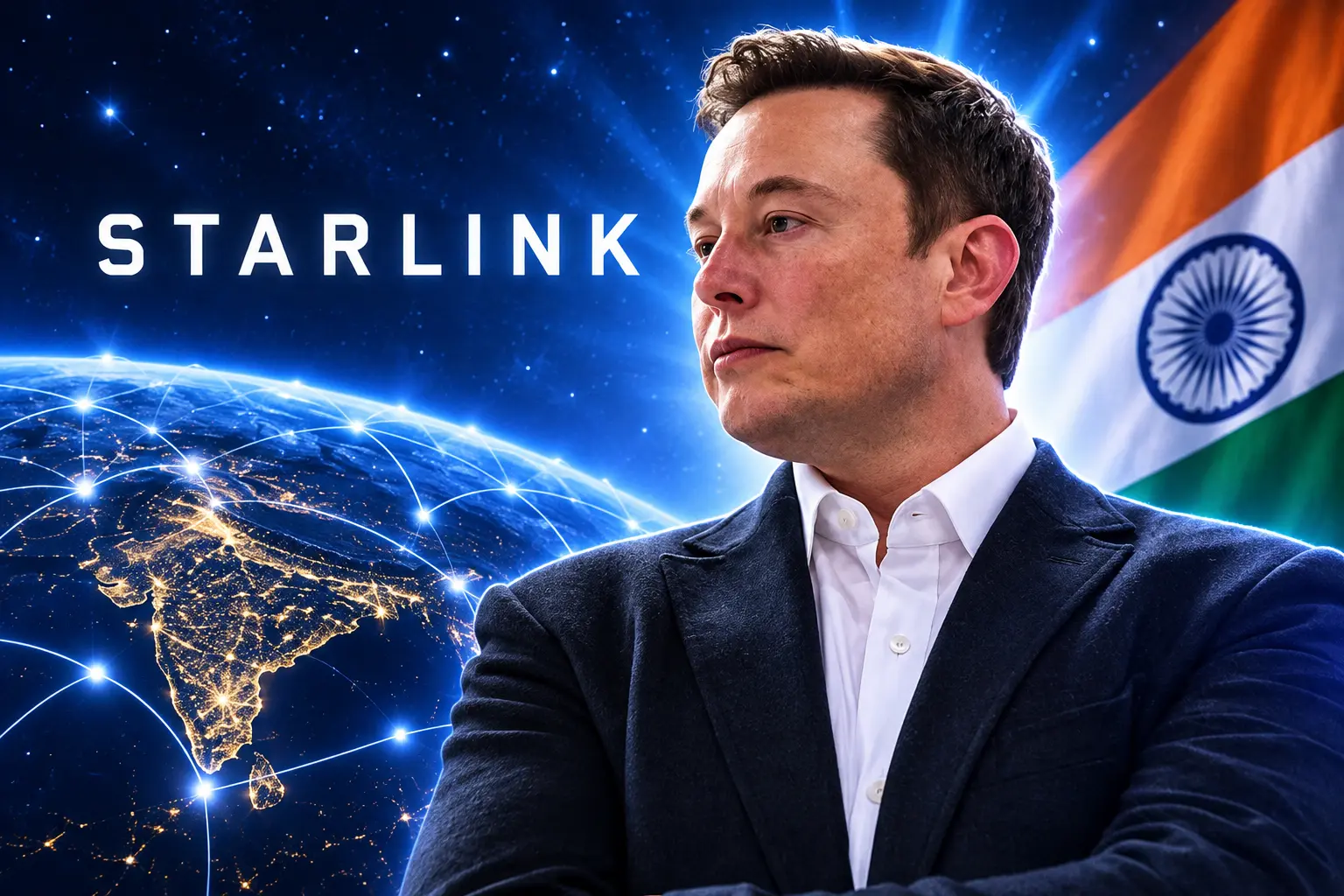
Elon Musk accused Indian oligarchs of blocking Starlink, but Jio and OneWeb sit in the same security queue and cannot launch either.

Elon Musk said on October 7, 2026 that unnamed Indian oligarchs are blocking Starlink to keep a monopolistic chokehold on consumers. The Ministry of Communications answered on October 8 that three licensed satellite operators are at broadly the same stage. Security assessments are still running for each of them.
Those three are Starlink, Bharti-backed Eutelsat OneWeb, and Jio Satellite Communications, a unit of Mukesh Ambani’s Reliance group. Jio and Sunil Mittal’s Bharti Airtel already lead Indian mobile service, and both signed Starlink distribution deals that have yet to sell a dish.
Musk Calls the Block a Crime Against India
Lauren Dreyer, vice president of Starlink business operations at SpaceX, told India Mobile Congress on October 7 that Starlink had spent five years with Indian regulators, operators and industry and had already put up 20 gateway sites with hundreds of antennas. The 11,000 Starlink satellites now in orbit, she said, already cover more than 170 countries, and the Indian build keeps user data inside the country.
We have already made the investment and built the existing ground infrastructure here: 20 gateway sites comprising hundreds of antennas, and we have established the operations to be ready to serve India.
Lauren Dreyer, Vice President of Starlink Business Operations, SpaceX, at India Mobile Congress 2026
Hours later, Musk replied to a post that listed uncovered Indian villages and Dreyer’s gateways. He named no company and no person. He still left little doubt about the charge.
Unfortunately, we are being blocked by certain oligarchs in order to maintain their monopolistic chokehold on the Indian people. You can guess who they are …
This is a crime against the people of India! https://t.co/t3YONgpcm7
— Elon Musk (@elonmusk) October 7, 2026
In a second post the same afternoon he said Starlink in India would enable high-speed, affordable Internet connectivity for people who cannot pay current prices or who have no link at all. By late evening he added that Starlink beams are turned off over India, calling claims that anyone had used the service there “absolutely false.”
The off-switch undercuts scare stories about unlicensed terminals. It also shows SpaceX already geofences the country from orbit, which is part of what New Delhi wants written into the commercial rules on the ground.
The Same Line for Starlink, Jio and OneWeb
The ministry’s note, issued through the Press Information Bureau at 9:19 a.m. on October 8, never named Musk. It answered “a post” that called India’s satellite rules unfair. The government said it had put in place a fair and non-discriminatory authorisation framework for all telecom services, satellite included, and had granted licences to three Global Mobile Personal Communication by Satellite operators using non-geosynchronous systems.
At present, all the three entities are at broadly the same regulatory stage. As such, the suggestion that the framework or its application is unfair or discriminatory is baseless and misconceived.
Ministry of Communications, Press Information Bureau, October 8, 2026
Every licensee, the note said, must show it meets security conditions meant to protect users and their data. When that check finishes for a firm, the firm may seek spectrum. Until then, no one in the trio moves to assignment.
That is a colder story than a private veto. If the point of the delay were only to shield Jio and Airtel’s mobile businesses, Jio’s own satellite arm and Bharti’s OneWeb stake would already be live. They are not. The paperwork has frozen the domestic hopefuls too.
Starlink’s India Partners Are Also Its Rivals
SpaceX announced memorandums of understanding with Jio and Airtel last year to roll Starlink out through their stores, towers and enterprise teams. Dreyer mentioned those ties again in New Delhi. The distribution path Musk needs in a market of a billion-plus connections runs through the same two private networks his post invited readers to “guess.”
Those networks are not waiting politely. Bharti already backs OneWeb, which holds the oldest of the three Indian satellite-broadband licences. Jio holds the second licence through Jio Satellite Communications and is drawing up a constellation it would own. The firms that would sell Starlink kits are also building, leasing or backing the systems that would compete with those kits.
That double role is why the oligarch frame is too neat. A carrier that wanted Starlink kept out of India would not also need a signed path to sell it. A carrier that wanted satellite revenue of its own would want the security file and the spectrum file to move, including for itself. Neither file has moved far enough for anyone to bill a household.
Neil Shah, a partner at Counterpoint Research, has said Starlink is likely to get a launch nod around the time Indian companies also field their own satellite internet, and that a launch without a “level playing field” would let Starlink dominate the category. That is a competition argument, and it is also a time argument. Every extra quarter the three licences stay parked is a quarter Jio can spend on a network that answers to Mumbai rather than Hawthorne.
Three Licences and Still No Customers
Minister of State for Communications Pemmasani Chandra Sekhar told the Rajya Sabha on January 29, 2026 that the Department of Telecommunications had issued a Unified License with GMPCS authorisation to three companies: OneWeb India Communications Private Limited, JIO Satellite Communications Limited, and Starlink Satellite Communications Private Limited. Amazon’s Kuiper application was still under examination. Nelco and Yotta had been rejected. Connect4sure had withdrawn.
THE THREE LICENSED OPERATORS
| Licensee | Indian backer | GMPCS licence | Still required |
|---|---|---|---|
| Starlink Satellite Communications | SpaceX | June 2025 | Security check, then spectrum |
| OneWeb India Communications | Bharti / Eutelsat | April 2022 | Security check, then spectrum |
| JIO Satellite Communications | Reliance Jio | October 2022 | Security check, then spectrum |
OneWeb has held paper rights for more than four years. Jio Satellite has held them since October 2022. Starlink received its GMPCS licence in June 2025 and authorisation from IN-SPACe, the space regulator, in July 2025. None of the three has a commercial customer in India, because a licence here is a ticket into the next waiting room, not a right to switch the service on.
Spectrum is the room after security. On May 9, 2025 the Telecom Regulatory Authority of India recommended that non-geostationary fixed satellite services pay 4% of Adjusted Gross Revenue as spectrum charges, plus Rs 500 a year per urban subscriber, with rural and remote users exempt from that extra levy, and with a minimum annual charge of Rs 3,500 per MHz. TRAI said the assignment should run up to five years, with a possible two-year extension. That formula is still a recommendation. It has not been turned into assigned airwaves for any of the three.
HOW THE FILE GOT THIS FAR
- 2021: Starlink takes Indian pre-bookings before it holds a licence, and the government orders refunds to more than 5,000 customers.
- April 2022: OneWeb India receives the first GMPCS licence of the three.
- October 2022: Jio Satellite Communications receives its GMPCS licence.
- May 9, 2025: TRAI publishes satellite spectrum recommendations, including a 4 percent AGR charge.
- June 2025: Starlink receives its GMPCS licence, valid through the Department of Telecommunications.
- July 2025: IN-SPACe authorises Starlink’s Indian space operations.
- January 29, 2026: The communications ministry names the three licensees in Parliament and says Amazon Kuiper is still under examination.
- October 7, 2026: Dreyer tells India Mobile Congress the ground network is built; Musk posts the oligarch charge.
- October 8, 2026: The ministry says all three remain at broadly the same stage.
The through-line is not a missing licence. It is a stack of later gates that the government insists every foreign and domestic operator must pass together.
What the Security Assessment Still Requires
Indian agencies have spent years asking how a foreign constellation can be boxed inside Indian law: user data kept on Indian soil, terminals that will not work if they are carried across a border, lawful intercept, and a way to shut the service during a crisis. Dreyer said Starlink had built “controls at every layer for India” and was keeping Indian user data in India. Musk’s own evening post said the beams over India are already off.
Rules discussed around the file also include a two-way geofence, so a dish bought outside India will not work here and a dish sold here will not work abroad. Home-ministry agencies have wanted confidence that India, not a foreign government, can command the system if those two demands collide. Starlink has disputed reports of a freeze, and the October 8 note puts the same security check on Jio and OneWeb as well.
WHAT STILL HAS TO CLEAR
- Security assessment: All three licensees must show they meet conditions meant to protect users and their data.
- Spectrum assignment: A firm may seek airwaves only after that security check is done.
- Pricing notification: TRAI’s May 2025 AGR formula is still waiting to be turned into assigned spectrum.
- Terminal controls: Dishes must be bound to India, with data local and a kill switch the government can trust.
Musk’s post treats that stack as a costume for private power. The ministry treats it as the price of a licence in a sensitive layer of the network. Both things can be true at once: incumbents have every reason to slow a rival with 11,000 satellites already flying, and New Delhi has every reason not to switch on a foreign system it cannot fence. The public record, as of October 8, is that the fence is still being inspected for everyone in the queue.
A Sovereign Constellation on Jio’s Drawing Board
Jio chairman Akash Ambani told shareholders in 2026 that the company that “connected India on the ground” now had to connect it from the skies, for villages, islands and border posts the terrestrial network cannot reach. “Jio is evaluating the development of a sovereign Low Earth Orbit satellite constellation for India,” he said. He also said Jio is leasing capacity from leading global operators so it can offer service sooner while it builds a network of its own.
That dual track is the part of the India story Musk’s post leaves out. Jio does not need Starlink to stay banned forever. It needs time, spectrum rules it can live with, and a political climate that treats a Reliance-owned sky network as safer than a SpaceX-owned one. Leasing fills the gap in the meantime, including, on paper, a path that once ran through Starlink itself.
A delay that also traps OneWeb and Jio Satellite is a blunt instrument if the only goal is to kneecap Musk. It is a more coherent instrument if the goal is to avoid handing the first working LEO broadband franchise in India to a company that already covers more than 170 countries. Shah’s warning about a missing “level playing field” is the clean version of that fear. Jio’s sovereign plan is the industrial version.
Cheap Mobile Data Already Reached Most of India
Musk’s consumer pitch is that Starlink would be cheaper than what Indians pay now, or would reach people who have no connection. The first half of that claim runs into the market Jio and Airtel already built. TRAI’s August 2026 subscription data put Reliance Jio at 508.43 million wireless subscribers, a 39.31 percent share, and Bharti Airtel at 491.60 million, or 38.01 percent.
TRAI’S AUGUST 2026 WIRELESS LEADERS
- Reliance Jio: 508.43 million subscribers, a 39.31 percent share.
- Bharti Airtel: 491.60 million subscribers, a 38.01 percent share.
- Vodafone Idea: 199.57 million subscribers, a 15.43 percent share.
- BSNL: 93.67 million subscribers, a 7.24 percent share.
India had 1,312.25 million wireless telephone connections at the end of August 2026 and 1,360.70 million telephone connections in all. This is not a dark-fibre country waiting for its first pipe. It is a mobile-data country whose two private leaders already price a gigabyte as a daily habit. Satellite broadband is a poor way to undercut that habit in cities. It is a better way to reach terrain where a tower never pays for itself, which is the case Dreyer actually made.
The honest last-mile case does not require a crime. It requires a security file that closes, spectrum that is assigned, and a retail plan that does not assume American hardware prices in a market trained on Jio tariffs. The MoUs with Jio and Airtel were the obvious way to solve the third problem. They cannot solve the first two, and those two still bind the partners as tightly as they bind Starlink.
Dreyer said she hoped that the next time she addressed the Congress, the government’s security work would be complete and Starlink would be authorised and ready. Until a security pass and a spectrum assignment arrive, the 20 Indian gateways she described will not sell a home connection, and neither will Jio Satellite or OneWeb.

Musk Blames Indian Oligarchs While Starlink Waits in Line

France Extends Its Soda Tax to Packaged Biscuits and Cereal

Hormel Bets $1.055 Billion on Brakebush Restaurant Chicken

Hyundai Bets the 2027 Tucson on Hybrids, Not Plugs

Hyundai Bets the 2027 Tucson on Hybrids, Not Plugs

EIF’s €30 Million Pushes Nordic Foodtech Close to €80 Million
Hyundai Bets the 2027 Tucson on Hybrids, Not Plugs

AI Agents Can Act, but Someone Has to Own Them

Ocarina of Time’s Australia Listing Matches Yoshi at $59.99

Newark’s Phone Ban Starts as a Storage Problem
-
 BUSINESS4 weeks ago
EIF’s €30 Million Pushes Nordic Foodtech Close to €80 Million
-
 AUTO6 days ago
Hyundai Bets the 2027 Tucson on Hybrids, Not Plugs
-
 NEWS1 month ago
AI Agents Can Act, but Someone Has to Own Them
-
 GAMING1 month ago
Ocarina of Time’s Australia Listing Matches Yoshi at $59.99
-
 NEWS1 month ago
Newark’s Phone Ban Starts as a Storage Problem
-

 NEWS1 month ago
LG Smart TVs Still Scan Homes Behind Apple TV
-

 NEWS1 month ago
Sembly 3.0 Makes Branded Decks and Shifts the Bottleneck
-

 NEWS1 month ago
Cheaper Tokens Made AI Deployments Cost Enterprises More