
BUSINESS
The Widow’s Suit Names Amazon’s Whole Cargo Chain
A Miami widow sued Amazon, 21 Air and the 767’s lessors after a Prime Air jet killed five cleaners on a public road the runway buffer did not stop.

Five airport cleaners died on Sept. 6 when a Prime Air Boeing 767 ran off Miami International’s Runway 30 and hit their van. On Sept. 9, the widow of the driver sued Amazon, the contractor that flew the jet, and the companies that own and lease it.
The National Transportation Safety Board has not named a cause. Yaraisi Santiso Morejon’s complaint already treats the crash as a chain of choices that runs from the cockpit through 21 Air LLC to Amazon’s cargo brand.
The Cleaning Crew on Northwest 67th Avenue
Yoel Rodriguez Naranjo, 53, was at the wheel of a 2012 Ford van for Professional Ocean Service Corporation, a contract cleaner for airlines. He was leaving the last job of the shift with six coworkers when 21 Air Flight 7598, inbound from San Juan, Puerto Rico, left the paved runway, tore through fencing, and struck the van, then a Toyota Corolla Cross on Northwest 67th Avenue.
Five of the seven people in the van were killed. Five other people were hurt, including both pilots, who were treated and released. Naranjo died on impact, according to attorney Jorge Garcia of Morgan & Morgan. He left his wife and their son, Ronaldo, 22. The family came from Cuba in 2011 and worked more than one job after they arrived, Garcia said.
The other dead were named by Miami-Dade authorities as Carlos Acosta Fajardo, 53; Rolando Aleman Leon, 55; Julio C. Pineda, 75; and Javierkys Reyes Quevedo, 47. None of them worked for Amazon. None of them were on the jet. They were on a service road and a public street that sit beyond the airport fence, in the path a 767 takes if it does not stop on Runway 30.
THE FIVE MEN KILLED
- Yoel Rodriguez Naranjo, 53: Van driver for the cleaning contractor, husband of the plaintiff, father of Ronaldo.
- Carlos Acosta Fajardo, 53: Cleaning-crew member in the same van; his family has hired separate counsel.
- Rolando Aleman Leon, 55: Cleaning-crew member named by the sheriff after the crash.
- Julio C. Pineda, 75: Oldest of the five, riding in the contractor van.
- Javierkys Reyes Quevedo, 47: Cleaning-crew member named with the others on Sept. 8.
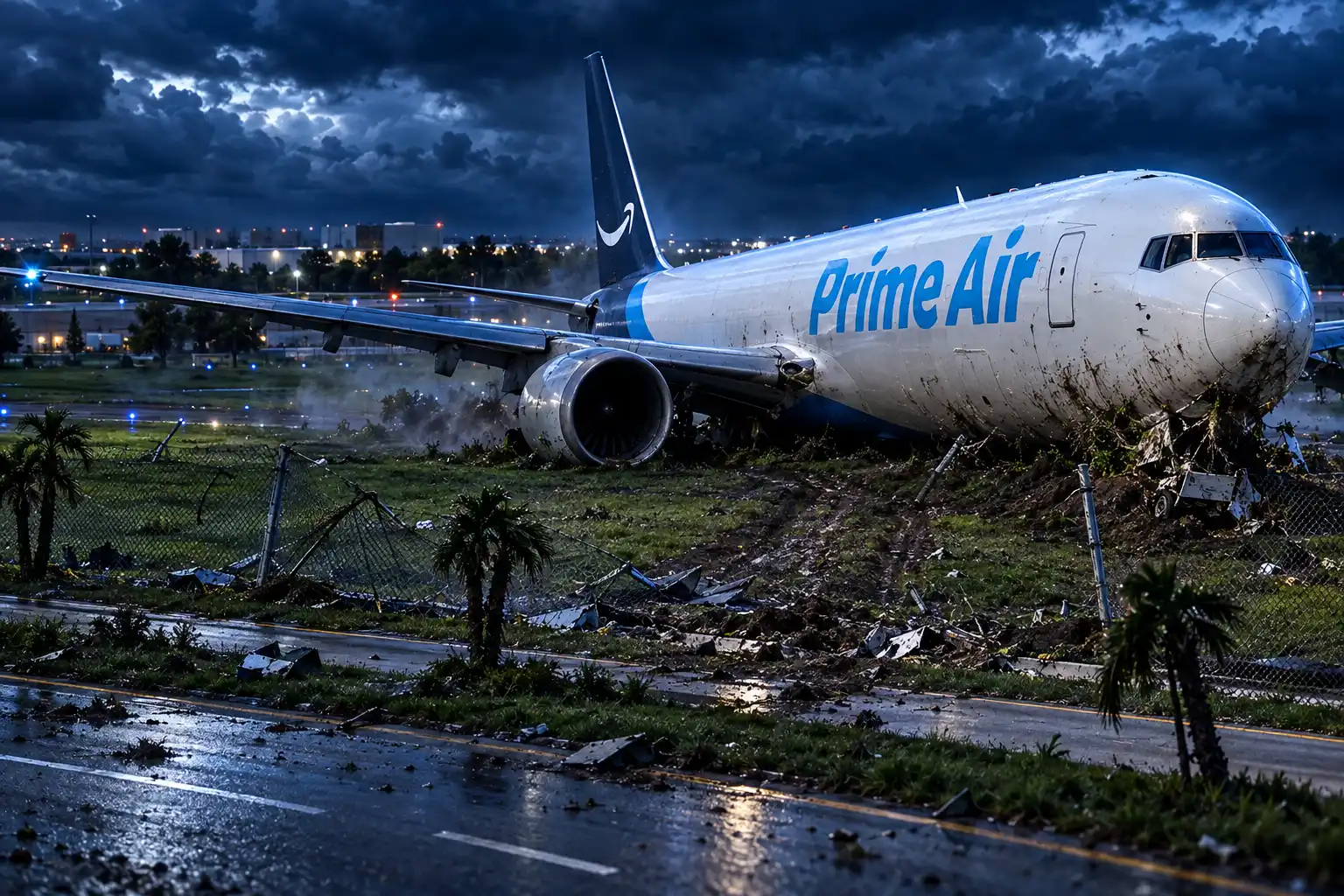
Attorney Mike Morgan told reporters the men were heading home when the jet arrived. The plane had already flown Cincinnati to Miami to San Juan that Sunday, its third trip of the day, before the return to Miami around 2 p.m. The wreckage path crossed the road and a second fence and stopped near a lot of Tesla robotaxis. NTSB photographs of the wreckage field show the burned fuselage, the crushed van, and the long debris line west of the runway.
Amazon Does Not Fly Its Own Prime Air Jets
The jet wore Prime Air colors. The operating certificate belonged to 21 Air, a Part 121 cargo airline based in Greensboro, North Carolina, with flying bases in Miami and at Piedmont Triad. Amazon Air, built in 2015, does not hold those certificates. It contracts FAA-certificated carriers to move freight under its brand, a setup Amazon called standard practice in passenger flying as well as cargo.
Industry tallies put about 105 jets in active Amazon Air service. Air Transport International flies about 40 of them. Sun Country flies about 22. 21 Air flies eight. Amazon began using 21 Air in late 2024, shifting Boeing 767 freighters that had been with Atlas Air. The accident aircraft, N1997A, a 767-33A converted by Israel Aerospace Industries, moved to 21 Air on a January 2025 sublease after years with Atlas.
The airframe was delivered in 1994 to Belgian charter carrier Sobelair and later flew for Vietnam Airlines, Air Europa, Kenya Airways, and Nordwind before the cargo conversion in 2016. NTSB investigator-in-charge Chihoon Shin said the planned landing weight was 231,236 pounds, including 32,000 pounds of cargo, well under the type’s landing limit of about 325,000 pounds. The freight was contact lenses from Puerto Rico.
Amazon spokesperson Kelly Nantel said every jet flown for the company is operated and maintained by an FAA-certificated carrier under FAA-approved programs, with licensed crews, recurrent training, and routine inspections. “We’ll fully cooperate with them and support any other investigating authorities and we’ll also continue to coordinate with 21 Air, which operated the flight,” she said. 21 Air chief executive Keith Winters said the company is working with the NTSB, the FAA, and local authorities, and opened a family line at 866-681-1193.
WHO HELD WHICH PIECE
| Party named | Role around Flight 7598 |
|---|---|
| Amazon.com and Amazon Air Cargo | Brand on the jet; sued for failing to oversee the flying |
| 21 Air LLC | Part 121 operator; employed the crew |
| Avia Acquisition and Avia Investments | 21 Air ownership vehicles tied to Jim Crane |
| Atlas Air Worldwide and Titan Aviation Leasing | Prior operator and lessor on the 767 |
| Andromeda Leasing II | Lessor named in the Miami-Dade complaint |
| Capt. Joseph Carroll and FO Jaime Felipe Silva Molina | Crew on the San Juan-Miami sector |
That stack is the point of the filing. Amazon’s public posture is that 21 Air flew the trip. Morejon’s lawyers named the brand, the operator, the ownership companies, the lessors, and both pilots in one complaint, arguing the duty of care does not stop at the operating certificate.
What the Recorders Caught in the Last 30 Seconds
Shin and NTSB Chair Jennifer Homendy released a Sept. 9 cockpit and flight-data readout that is still preliminary. The cockpit voice recorder held more than two hours of good audio on four channels. The flight data recorder held about 54 hours and more than 400 parameters. The two boxes have not been time-synced yet.
On the voice tape, the crew checked in with Miami tower at 04:18 before the end of the recording and was cleared to land on Runway 30. Flaps moved in steps from 1 degree to 30. At 01:42, a pilot called for flaps 20 and the other pilot said they were too fast. Speed comments continued for the rest of the tape. There was not a consistent verbal reply. Autopilot disconnected at 01:23. Electronic “sink rate” and “too low terrain” calls followed, the terrain warning four times at 00:48 and again at 00:39. Sounds like touchdown came at 00:31. A pilot called for a go-around at 00:15. Sounds like leaving the pavement came at 00:10.
The flight-data tape is the cleaner clock for the landing itself. Typical 767 target speeds sit in a 130 to 145 knot band. This jet’s first contact was faster, and it was not on all three gears.
THE LAST 30 SECONDS ON THE FLIGHT RECORDER
- 00:30: Nose gear and right main gear touch down at 158 knots, about 182 mph.
- 00:23: Wheel brakes come on at 146 knots.
- 00:19: Left main gear finally touches at 134 knots.
- 00:15: Brakes come off at 120 knots; throttles rise to go-around thrust.
- 00:11: Throttles go to idle; brakes come back on at 117 knots and stay on.
- 00:07: Lateral, longitudinal, and vertical accelerations change sharply at 96 knots.
- 00:00: Recording ends at 65 knots, about 75 mph, with no speed brakes or thrust reversers shown as deployed.
On a 767, both main-gear bogies need to be down before armed speed brakes or thrust reversers will deploy on their own, though crews can still work the speed brakes and wheel brakes by hand. The left gear was still in the air when the first brakes went on. Four seconds after both mains were down, the crew came off the brakes and pushed up for a go-around, then reversed that call. Homendy said investigators still had to hear the pilots’ own account of those throttle moves.
Carroll, 55, had 7,145 total hours and received his 767 type rating in May, Homendy said. First officer Silva Molina, 37, had 2,655 hours and received his 767 rating in April 2025. Time in type was not given. ADS-B tracks and videos put first contact at least 4,000 feet down the 9,360-foot runway, past the usual 3,000-foot touchdown zone. Shin did not adopt that distance as a board finding. Weather at the field included a thunderstorm, winds from 190 degrees at 17 to 26 knots, broken clouds, and 10 miles of visibility.
The Widow Named Every Link in the Lease Chain
Morejon filed in the Circuit Court of the Eleventh Judicial Circuit in Miami-Dade County on Sept. 9, three days after the crash. The complaint seeks more than $50,000, the floor that puts a Florida circuit case in play, plus punitive damages and a jury. It alleges negligence, product liability, and wrongful death. It also cites prior 21 Air employee complaints about rest, English, write-ups, and jets kept flying with open problems.
This disaster was not an unavoidable accident. It was the foreseeable and preventable result of multiple, concurrent failures: pilot error by Defendants Joseph Carroll and Jamie Felipe Silva Molina in attempting a high-speed, tailwind-affected landing while failing to execute a mandatory go-around; a systemic failure by Defendants Amazon and 21 Air to ensure adequate pilot training, fitness, and sound aeronautical decision-making; the deployment of a 32 year-old aircraft by all pertinent Defendants whose braking, thrust reverser, and spoiler systems are under active NTSB investigation.
Yaraisi Santiso Morejon, complaint, Miami-Dade Circuit Court
Mike Morgan said the harm runs “from the pilots to the owners of the airplane to the lessors of the airplane to the people that engage the lessors of the airplane.” Garcia said Amazon had not contacted the family when the case went in. John Morgan called it a preventable tragedy. Filing that fast drew a hard public reaction, the charge that lawyers reached the family before the board finished the facts. The firm said it needed evidence held and the estate’s rights preserved while the NTSB work continues. A Miami-Dade complaint at the $50,000 floor is how those cases open. It is not a valuation of five deaths.
The airframe had more than 107,000 hours and 23,204 cycles. Age alone does not make a 767 unairworthy. Converted passenger jets of that vintage are common in cargo. The complaint treats the age, the stopping systems now under review, and the training file as one fact pattern. Homendy has not joined those dots.
Karl Seuring, Don Helmig and the Paper Trail
The operator in the middle of that chain already had a paper trail. Karl Seuring, a 21 Air pilot with more than 30 years of flying and a former union president there, has a live Department of Labor case after OSHA rejected his claim that he was fired for raising safety issues. He said a manager told him, “It’s not going to change.”
Former chief pilot Bruce Joseph testified in that tribunal that people were discouraged from logging concerns “on numerous occasions,” and that most items never went into the safety software unless he pushed. Former chief executive Mike Mendez testified that Joseph left “under very bad circumstances” and was inventing damage. “My responsibility is to make sure we run a safe airline, not to hurt people and not to hide anything,” Mendez said. He declined a later interview.
Seuring described an April 13, 2022, jump-seat ride on a 21 Air 767 out of Newark in which a mechanical problem kept the jet accelerating after takeoff, past speeds that can hurt the flaps. He said there was no debrief. He also described a 2022 Alabama-to-Trinidad flight that, he said, diverted to Puerto Rico with a pressurization problem. Former fleet manager Amir Anoshiravani denied that event and said Seuring was angry because he was fired.
It’s something a lot of us ex-21 Air pilots have been anticipating for a while.
Tony Bless, retired 21 Air pilot
Bless pointed to maintenance deferrals, radar failures, and the quality of new hires. Seuring said crews saw fuel leaks, circuit breakers, and smoke in the cockpit, and that pilots were coached on how write-ups should read. Don Helmig, a former fighter pilot hired to look at safety policy, resigned on June 12, 2021, in an email to majority owner Jim Crane, who also owns the Houston Astros. “After three months, everywhere I looked there are issues,” Helmig wrote. He accused the company of paying “lip service” to its safety system “then doing exactly nothing.”
Amazon’s reply to that file was narrow. A spokesperson said the company would defer to the NTSB on the crash and to 21 Air “regarding these allegations that pre-date our relationship with the company.” The Amazon flying started in late 2024. The Helmig letter is from 2021. Seuring’s Newark ride is from 2022. The suit still asks a jury to treat training, rest, and oversight at 21 Air as Amazon’s problem once the jet is in Prime Air colors and on Amazon’s network.
Runway 30 Had the Buffer the FAA Required
The jet ran about 1,300 feet past the pavement. Homendy said the board will look at the absence of an engineered materials arresting system on that runway end. Miami International does not have one on Runway 30. It does have the standard runway safety area: 1,000 feet long and 500 feet wide, level and mostly clear, a layout set in the 1980s and later made mandatory for new and rebuilt runways. A 400-foot blast pad sits in that gap. The road the 767 crossed is about 1,300 feet from the runway end, a geometry that dates to a 1986 airfield move.
The FAA uses crushable arrestor beds at runway ends when a full safety area will not fit. FAA data cited in the board’s briefings count 70 U.S. airports with 120 of those beds. A standard bed is built to stop most aircraft entering at 70 knots, about 80 mph. This 767’s last recorded speed on the pavement side of the event was well above that design case. Homendy asked whether every airport should have a bed anyway. Miami-Dade’s aviation department has said EMAS is an alternative to a full safety area, not a second layer on top of one.
So the field met the rule and still put a cleaning van and a Toyota on the far side of a 767. The people with the most at stake were not on Amazon’s payroll. They were on a contractor’s shift, on a road the RSA was supposed to keep jets from reaching. The suit that landed on Sept. 9 asks a Miami-Dade jury to treat Amazon as more than a customer of 21 Air. The NTSB has not said who, if anyone, made the landing unrecoverable. Those two clocks are now running at the same time.
Disclaimer: This article is news reporting on a civil complaint and an open federal accident inquiry. It is for information only and is not legal advice, does not judge liability, and does not tell any reader whether to sue, settle, or testify. Anyone with a claim, defense, or insurance question after the Sept. 6 crash should speak with a licensed Florida attorney who can review the actual docket and the NTSB record. Facts, names, and figures here reflect the complaint, company statements, and board updates available on Sept. 9, 2026, and those items can change as the case and the inquiry move.

Musk Blames Indian Oligarchs While Starlink Waits in Line

France Extends Its Soda Tax to Packaged Biscuits and Cereal

Hormel Bets $1.055 Billion on Brakebush Restaurant Chicken

Hyundai Bets the 2027 Tucson on Hybrids, Not Plugs

Hyundai Bets the 2027 Tucson on Hybrids, Not Plugs

EIF’s €30 Million Pushes Nordic Foodtech Close to €80 Million
Hyundai Bets the 2027 Tucson on Hybrids, Not Plugs

AI Agents Can Act, but Someone Has to Own Them

Bass Persuades Puts Miley Back at No. 1 on Sales

Ocarina of Time’s Australia Listing Matches Yoshi at $59.99
-
 BUSINESS1 month ago
EIF’s €30 Million Pushes Nordic Foodtech Close to €80 Million
-
 AUTO3 weeks ago
Hyundai Bets the 2027 Tucson on Hybrids, Not Plugs
-
 NEWS1 month ago
AI Agents Can Act, but Someone Has to Own Them
-
 ENTERTAINMENT3 weeks ago
Bass Persuades Puts Miley Back at No. 1 on Sales
-
 GAMING1 month ago
Ocarina of Time’s Australia Listing Matches Yoshi at $59.99
-

 NEWS1 month ago
Newark’s Phone Ban Starts as a Storage Problem
-

 NEWS1 month ago
LG Smart TVs Still Scan Homes Behind Apple TV
-

 NEWS1 month ago
Sembly 3.0 Makes Branded Decks and Shifts the Bottleneck