
BUSINESS
Meghalaya Tightens MHIS Hospital Claim Audits, and Care Waits
Meghalaya’s MHIS now audits hospital claims on a mobile app with a 15% error cap and a 5% fine, while remote wards still fight queries.

Meghalaya now audits Megha Health Insurance Scheme hospital bills on a phone app, with a 15% error cap and a 5% fine. The change is meant to stop padded claims. In the hills, it also slows the paperwork that stands between a family and cashless care.
Researchers at the Generating Research Insights for Development (GRID) Council in Noida, writing in the Indian Journal of Medical Research, reconstructed how those checks grew from loose insurer visits into risk-based digital audits as MHIS moved from Phase V to Phase VI. They did not interview patients. They spoke to the people who run the machine.
The App That Follows Every Hospital Claim
R. Mukherjee, N.D. Ladia, Dr Archisman Mohapatra and colleagues ran a qualitative study of 27 stakeholders, then held three extra talks with State Nodal Agency (SNA) leaders. Seven of the interviews were with state officials, the insurer and outside experts. Twenty were with medical officers, nurses and specialists in public and private wards. Fieldwork ran through 2023-24. The journal received the paper on 13 February 2026 and accepted it on 6 April 2026 (doi 10.25259/IJMR_565_2026).
MHIS, launched in 2012 and run with Ayushman Bharat Pradhan Mantri Jan Arogya Yojana since 2019, covers every resident except serving government staff. A March 2026 SNA service contract puts enrolment at 21,29,664 people in 6,44,952 families, 93% of households on the scheme database. Cover is ₹5.3 lakh (~$6,200) per family a year, of which ₹5 lakh is for inpatient care and ₹30,000 is for outpatient work such as maternity visits, child care, heart and diabetes follow-up, and tests. Reliance General Insurance Company Limited holds the Phase 6 policy.
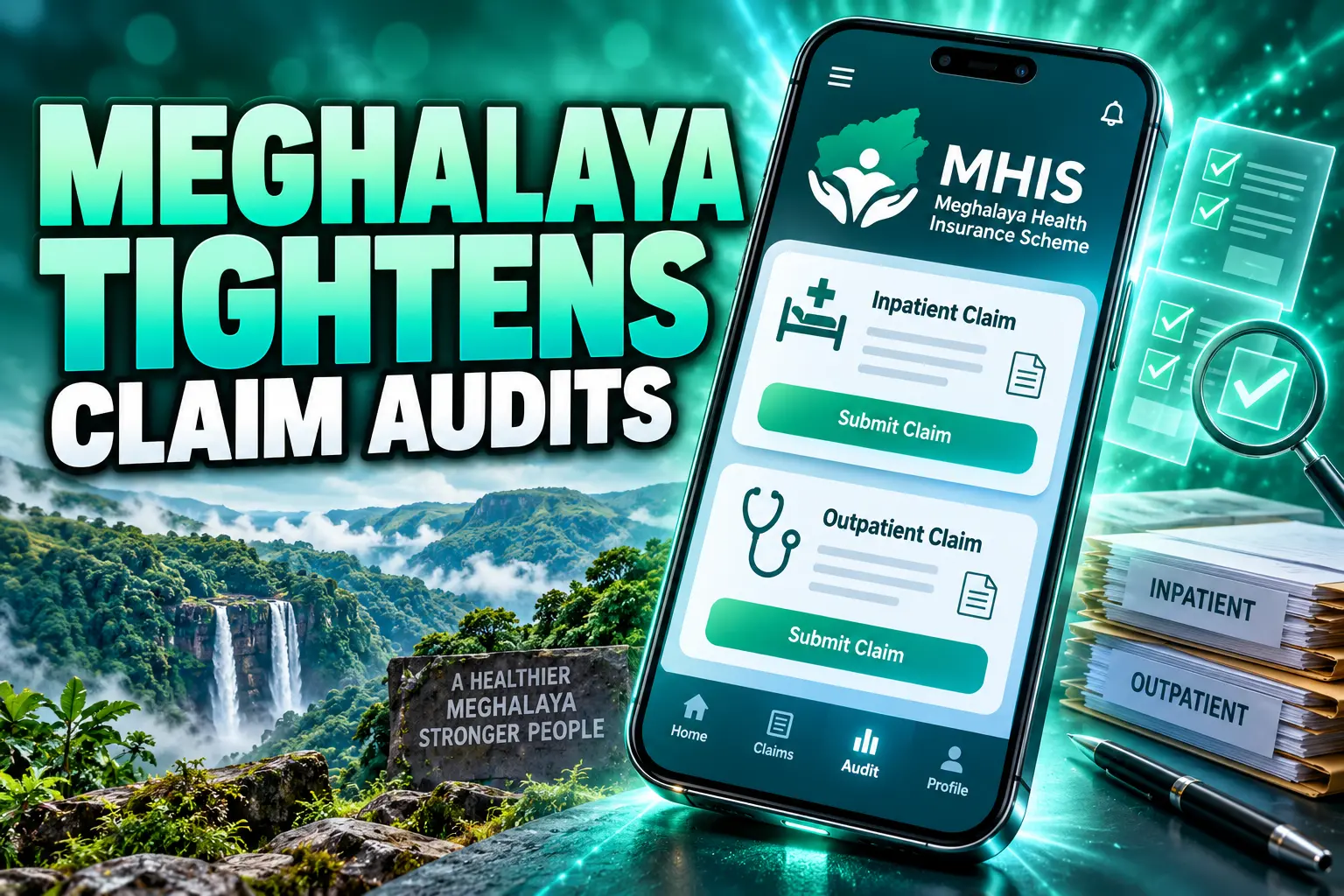
From September 2023 the medical audit itself moved onto a mobile app. Auditors now use separate forms for inpatient, outpatient, daycare and death cases. If a hospital’s paperwork diverges from the file by more than 15%, the scheme can levy a 5% financial penalty. An anti-fraud specialist, 41, told the researchers that fines matter because “hospitals tend to ignore non-financial directives.”
MHIS IN FIGURES
- Family cover: ₹5.3 lakh a year, including ₹30,000 for outpatient care.
- People on the books: 21,29,664 beneficiaries in 6,44,952 families (93% of listed households).
- Claims since 2019: more than 11 lakh bills, worth ₹1,126 crore, in the SNA contract.
- Phase 6 premium: ₹2,824.10 per household, 38% higher than in 2019, with the state spending about ₹160 crore a year.
CEO Evarinia Liza Warjri, MCS, says the scheme has cut household medical bills by about ₹1,400 crore through mid-2026, with 13 lakh cards seeded to Aadhaar and near-full empanelment inside the state, plus access to about 40,000 PM-JAY hospitals elsewhere in India. Those are system counts. They are not a patient survey.
Doctors Tie Cleaner Records to Tighter Audits
The people GRID interviewed described a public hospital that learned to keep a file because the file now pays. Scheme money bought drugs, reagents, power backup, computers, beds and, in one account, the first proper drip stands a primary health centre had ever owned.
When they first started admitting patients, the PHC didn’t even have IV stands. They had to use bamboo as makeshift IV stands. From such humble beginnings, the facilities have significantly improved, with much of this progress attributable to MHIS.
Medical officer, East Garo Hills, Indian Journal of Medical Research study
A colleague in East Khasi Hills put a number on the loyalty: “I’ll say to this extent, about 90% is due to MHIS only.” Another ward in the same district said inpatient numbers went from “hardly touching 400” in 2019 to “crossed 816” in 2024. Staff said weekly checks felt less like a raid than a habit. “Weekly audits are not fault-finding but fact-finding exercises that help us improve our practices,” a medical officer in East Jaintia Hills said.
Medicine stocks, they said, now last. One South West Garo Hills officer said MHIS funds let the hospital “provide free medicines to people who would otherwise be unable to afford or access them.” A North Garo Hills staff nurse, 40, watched the difference at the window: card holders left with drips and injections paid; families without a card still bought outside. That contrast, she said, is what finally sent people to enrol.
Several wards used the same paperwork to chase quality badges, including PM-JAY bronze certification. Incentives from settled claims, officers said, changed how staff treated patients, because rude care meant fewer return visits and a thinner claim book.
What Happens When a Claim Misses the 15% Line
The same interviews show the cost of that discipline. The 15% cap and the 5% fine sit on top of a transaction system that already demands a pre-authorisation, a matching package code, clinical notes, and a claim filed within 30 days of discharge. Public hospitals get five days of backdating on medical packages when the network fails; private hospitals get three. Miss the window, and a surgical case can be forced into an “unspecified” medical package that pays less and invites more questions.
WHERE THE AUDIT RUBS
- The file: Nurses said the first standard packs ran to so many pages that wards wondered how they would finish a shift, even if later practice made the forms faster.
- The queries: Officers described one insurer question breeding the next, with partial payments and long reconciliations.
- The signal: A South West Khasi Hills nurse said thin bandwidth stalled the transaction system and stacked unsent claims when the line died.
- The code: In East Khasi Hills, data-entry staff with no medical training pick and block packages, which doctors said seeds the very mismatches auditors then flag.
- The card: Remote patients still arrive with no Aadhaar, voter ID or birth certificate, and some families were quoted about ₹1,000 to complete Aadhaar enrolment.
Those frictions are not a footnote to the 15% rule. They are how the rule meets a hill PHC. Package errors by clerks become discrepancy scores. Discrepancy scores become penalties or stalled rupees. Stalled rupees become a ward that thinks twice before admitting the next cashless case.
Even after clarifying a query, another is asked. It is query upon query. We are so frustrated having to come back to [clarify] again and again.
Medical officer, 34, East Garo Hills, Indian Journal of Medical Research study
A PHC doctor in East Khasi Hills added a plainer limit: the insurer wants scans, X-rays and lab panels the centre does not have. An East Garo Hills officer, 34, said registration is still the first wall, because “many of the patients does not have any document, even ID card, no birth certificate.” In Shillong, an MHIS nodal officer, 37, listed homeless patients and medico-legal cases with no papers at all. Early on, some patients even treated the MHIS card like an ATM and refused to use it, fearing the hospital was drawing cash from them.
GRID is clear about the gap this leaves. The team did not measure health outcomes or sit with beneficiaries. SNA co-authors, the journal notes, stayed out of the analysis. System voices can over-praise their own files. They can also miss the family still waiting in a corridor while a clerk re-blocks a package.
Six Phases Narrowed the Room for Error
The 15% line did not arrive in one memo. Each MHIS phase answered a mess the last phase had found, and each answer added a form, a committee or a fine. Audits barely existed in Phase I, when the SNA was busy issuing cards. They became a state job in Phase II after high use in late 2015. By Phase III a Claim Audit Parameter Review Committee had designed 21 standard medical forms and set a 25% discrepancy tolerance. Phase IV, which also folded in PM-JAY and raised cover to ₹5 lakh, cut that tolerance to 15% and split the audit into four case types from May 2021. Phase V, with cover at ₹5.3 lakh, added the 5% penalty. Phase VI put the same rules on a phone.
HOW MHIS TIGHTENED THE CLAIM CHECK
| Phase | Period | Family cover | Audit change |
|---|---|---|---|
| I | December 2012 to April 2015 | ₹1.6 lakh | Insurer-run, unstructured, SNA not in the audit |
| II | May 2015 to April 2017 | ₹2.0 lakh | SNA quality checks from January 2016 after high use |
| III | May 2017 to November 2018 | ₹2.8 lakh plus ₹30,000 for enrolled seniors | 21 standard forms, 25% discrepancy tolerance, district medical officers as auditors |
| IV | December 2018 to August 2022 | ₹5.0 lakh | Four formats (inpatient, death, outpatient, daycare); tolerance cut to 15% |
| V | September 2022 to August 2023 | ₹5.3 lakh | 5% penalty when discrepancy exceeds 15% |
| VI | September 2023 onward | ₹5.3 lakh | Same rules, run on a mobile app |
The paper’s own trend chart, described but not reprinted in full numbers, says more claims were pulled for audit over time while the share with errors fell and then levelled off. That is the intended arc: more eyes, fewer mistakes. It does not tell you how long a clean claim waited in the queue, or how many families in East Garo Hills walked away before a clerk found an ID.
An older, separate look at the books still shapes who feels a delayed rupee. Eliza K. Dutta and colleagues at the Indian Institute of Public Health Shillong, using 2013 to 2018 enrolment files, found that 57% of claims went to 18 private hospitals and 39% to 159 public facilities, with “General Ward Unspecified” the biggest single package by volume and money. If private wards still hold a large slice of the payout, a 5% penalty and a query stack land first on the hospitals that already take most of the cash, and on the public PHCs that can least spare a clerk.
September 2024, When Private Wards Said Stop
The GRID interviews treat delay as an audit-and-network problem. Meghalaya has already watched a different delay, the payment rail, shut wards. Those are not the same bottleneck, and they hit the same helpdesk.
In early September 2024, private hospitals in Shillong paused MHIS work over unpaid bills, then resumed with a deadline for the state to clear dues. Then health minister Ampareen Lyngdoh said that after rejections a claim of ₹48 crore was pending, including ₹18 crore for private hospitals, and that the insurer had approved sums that were stuck on technical platforms. SNA chief executive Ramkumar S. said 1,89,018 cases were raised from 1 September 2023 to 31 August 2024, of which 1,55,211 had been approved and 29,415 were still pending, and that ₹3.59 crore was released between 2 and 9 September 2024. National Health Authority teams were pulled in. The first Phase 6 policy year was extended.
A year later the political temperature was still on the queue. In August 2025 the chief minister called for faster action on delayed MHIS claims, and the health minister reviewed the scheme. By 16 February 2026 the SNA was still training its own staff on fresh Transaction Management System rules for a Claims Review Committee and a Medical Audit Committee, which is how a digital audit actually lives: not as a finished app, but as another round of workshops while claims keep arriving.
The Staff of the SNA – MHIS PMJAY, have conducted training’s on the newly deployed changes in the TMS regarding the Claims Review Committee (CRC) and Medical Audit Committee (MAC), ensuring seamless continuity of operations. @AyushmanNHA @meghalayahealth @CMO_Meghalaya pic.twitter.com/Ma0r7ZKAKd
— MHIS-PMJAY (@MHIS_Megha) February 16, 2026
That sequence is the second-order fact the journal paper almost names. Tighten the file, and you also thicken the pipe. When the pipe clogs, it is not an anti-fraud officer who sleeps in the corridor. It is a BPL patient whose surgery date moved, as private hospitals said happened when they briefly walked out.
Phase 7 Is Being Drawn Without Patient Interviews
The third Phase 6 policy was set to close in August 2026. The official FAQ still listed ₹5.3 lakh cover, cashless treatment and open enrolment at district kiosks at the end of September 2026, which is how the scheme was still being described to the public. Phase 7 had not been notified. It was being designed.
A March 2026 service contract asks a consultancy to test a higher cover of ₹7.30 lakh or ₹10.30 lakh, to rebuild the health benefit packages that have not had a full study since 2021-22, and to weigh a premium-sharing model so the state is not carrying about ₹160 crore a year alone. It also asks whether to fold in about 68,280 government employees, 24,044 pensioners and a reimbursement population of about 4,43,155 people who now wait, on average, six months for a paper refund. An MHIS Policy Committee notified on 8 September 2025 and meeting on 1 December 2025 set that work in motion. Target households on the Phase 6 books were 6,92,979, of which 3,85,708 sat under PM-JAY and 3,07,271 under the state top-up, against more than 2,400 medical and surgical packages.
None of that redesign, on the face of the contract, commissions the study GRID said was still missing: interviews with the people who carry the card. Officers already say cashless care, full drug kits and better buildings followed the audit. They also say a dropped tower, a clerk’s package guess and a missing Aadhaar can still turn a “free” admission into a two-day argument. Phase 7 can raise the ceiling, add pensioners and teach the Medical Audit Committee another module. It will not know whether a woman in South West Khasi Hills left the window because the app would not load, until someone asks her.
Mohapatra’s team put the limit in one line. They reconstructed how the state taught hospitals to fear a messy file. They did not follow the patient who needed the file to open.
Disclaimer: This article is news reporting on a published research paper and on official Megha Health Insurance Scheme documents. It is for information only and is not medical, insurance or legal advice, and it does not tell any reader whether to enrol, claim, or refuse a hospital bill. Anyone who needs care or a claim decision should speak to a treating doctor and to the MHIS helpdesk or district kiosk that handles their card. Enrolment counts, package rules, premiums, penalties and pending-claim totals are those given in the sources named above and can change when Phase 7 is notified or when an insurer posts a new settlement run.

France Extends Its Soda Tax to Packaged Biscuits and Cereal

Hormel Bets $1.055 Billion on Brakebush Restaurant Chicken

Hyundai Bets the 2027 Tucson on Hybrids, Not Plugs

Hyundai Bets the 2027 Tucson on Hybrids, Not Plugs

Anthropic Chases a $2 Trillion Listing Before Thanksgiving
Hyundai Bets the 2027 Tucson on Hybrids, Not Plugs

AI Agents Can Act, but Someone Has to Own Them

EIF’s €30 Million Pushes Nordic Foodtech Close to €80 Million

Newark’s Phone Ban Starts as a Storage Problem

Ocarina of Time’s Australia Listing Matches Yoshi at $59.99
-
 AUTO3 days ago
Hyundai Bets the 2027 Tucson on Hybrids, Not Plugs
-
 NEWS4 weeks ago
AI Agents Can Act, but Someone Has to Own Them
-
 BUSINESS3 weeks ago
EIF’s €30 Million Pushes Nordic Foodtech Close to €80 Million
-
 NEWS4 weeks ago
Newark’s Phone Ban Starts as a Storage Problem
-
 GAMING4 weeks ago
Ocarina of Time’s Australia Listing Matches Yoshi at $59.99
-

 NEWS4 weeks ago
LG Smart TVs Still Scan Homes Behind Apple TV
-

 NEWS4 weeks ago
Sembly 3.0 Makes Branded Decks and Shifts the Bottleneck
-

 NEWS4 weeks ago
Cheaper Tokens Made AI Deployments Cost Enterprises More